

Aurora Office Furniture opened its doors in 1993 – a family business with a simple promise: make setting up an office effortless. Three decades and three generations later, that promise hasn’t just survived, it’s become the company’s DNA. Aurora’s strength lies in doing the hard part so their clients don’t have to and has built a reputation for knowing this business inside out.
MD Dean Grace didn’t start behind a desk; he spent eight years installing furniture on major projects before stepping into leadership. That ground-up perspective shapes the way Aurora operates: practical, reliable, and genuinely focused on getting it right.
And now Dean has a bold vision: to grow the business tenfold over the next three years. That’s not a modest stretch target; it’s a fundamental step-change that will require Aurora to rethink how it attracts clients, scales its operations, and positions itself in an increasingly competitive market. The foundations are solid – the reputation, the expertise, the relationships are all there. What’s needed now is a clear, actionable strategy to turn that ambition into reality.
MD Dean Grace didn’t start behind a desk; he spent eight years installing furniture on major projects before stepping into leadership. That ground-up perspective shapes the way Aurora operates: practical, reliable, and genuinely focused on getting it right.
And now Dean has a bold vision: to grow the business tenfold over the next three years. That’s not a modest stretch target; it’s a fundamental step-change that will require Aurora to rethink how it attracts clients, scales its operations, and positions itself in an increasingly competitive market. The foundations are solid – the reputation, the expertise, the relationships are all there. What’s needed now is a clear, actionable strategy to turn that ambition into reality.

“drive growth through customer demand”
There are plenty of ways to chase growth – hire aggressively, open new locations, pour money into marketing and hope the phones start ringing. But for a business like Aurora, with 30-plus years of hard-earned credibility, there’s a smarter path: drive growth through customer demand.
It’s a subtle but important distinction. Rather than building capacity first and then scrambling to fill it, we flip the sequence. We start by generating demand – more enquiries, more projects, more repeat business – and let that demand pull the organisation forward. As demand grows the need for additional people, systems, and infrastructure becomes obvious and immediate. Growth stops being a top-down directive and starts feeling like the natural, inevitable next step.
This strategy:
There are plenty of ways to chase growth – hire aggressively, open new locations, pour money into marketing and hope the phones start ringing. But for a business like Aurora, with 30-plus years of hard-earned credibility, there’s a smarter path: drive growth through customer demand.
It’s a subtle but important distinction. Rather than building capacity first and then scrambling to fill it, we flip the sequence. We start by generating demand – more enquiries, more projects, more repeat business – and let that demand pull the organisation forward. As demand grows the need for additional people, systems, and infrastructure becomes obvious and immediate. Growth stops being a top-down directive and starts feeling like the natural, inevitable next step.
This strategy:
- keeps shareholder attention on customers, the market, and the work – rather than getting bogged down in internal restructuring before there’s a clear reason for it. The team stays focused on what Aurora has always done best: looking after customers.
- enables growth to pay for itself. New hires, new tech, expanded operations – these investments are funded by revenue that’s already on the books, not by cash reserves spent on a bet that business will eventually catch up. For a family business built on three decades of careful stewardship, that’s just sensible financial management.
- gives us time to design the right systems and processes to meet demand with absolute clarity. Then as demand grows, we put the processes, systems, and infrastructure in place to meet it – not too early (when it’s guesswork) and not too late (when it’s a crisis). Each stage of growth informs the next, and Aurora scales with confidence rather than chaos.

In my experience, the only way of keeping a project of this nature on track is by building a clear framework of Plan/Act/Learn/Adapt
Weekly
Set up a weekly cadence for check-in/accountability sessions based on a Kanban board
Monthly
Monthly planning sessions
Quarterly
Quarterly review meetings to assess performance and adjust process
Milestones/targets
One month outlook - weekly milestones/targets
Six month outlook - monthly milestones/targets
One year outlook - quarterly milestones/targets
Three year outlook - annual milestones/targets
Notional plan structure - for discussion and review:
Weekly
Set up a weekly cadence for check-in/accountability sessions based on a Kanban board
Monthly
Monthly planning sessions
Quarterly
Quarterly review meetings to assess performance and adjust process
Milestones/targets
One month outlook - weekly milestones/targets
Six month outlook - monthly milestones/targets
One year outlook - quarterly milestones/targets
Three year outlook - annual milestones/targets
Notional plan structure - for discussion and review:
Discovery process
- Customer value cycle
- How do you create value for customers?
- How do you deliver value for customers?
- How do you capture value and make a profit?
- How do you know everything goes as planned
- People
- Tech stack
Customer value cycle
- Do you have a written document—not just “everyone knows this”—describing your key customers and their needs?
- Do you use it at least once a week to make important decisions?
- Do you have a list of key value drivers—the specific ways you create value that set you apart from competitors?
- If I stop three of your executives in the corridor and ask them to list your value drivers, will all three give the same answer?
- Do you have a document listing the key assets and processes you need to develop to make your business model work?
- How exactly do you turn your value drivers into profit?
- How does your feedback loop work to tell you what your customers really think about your products?
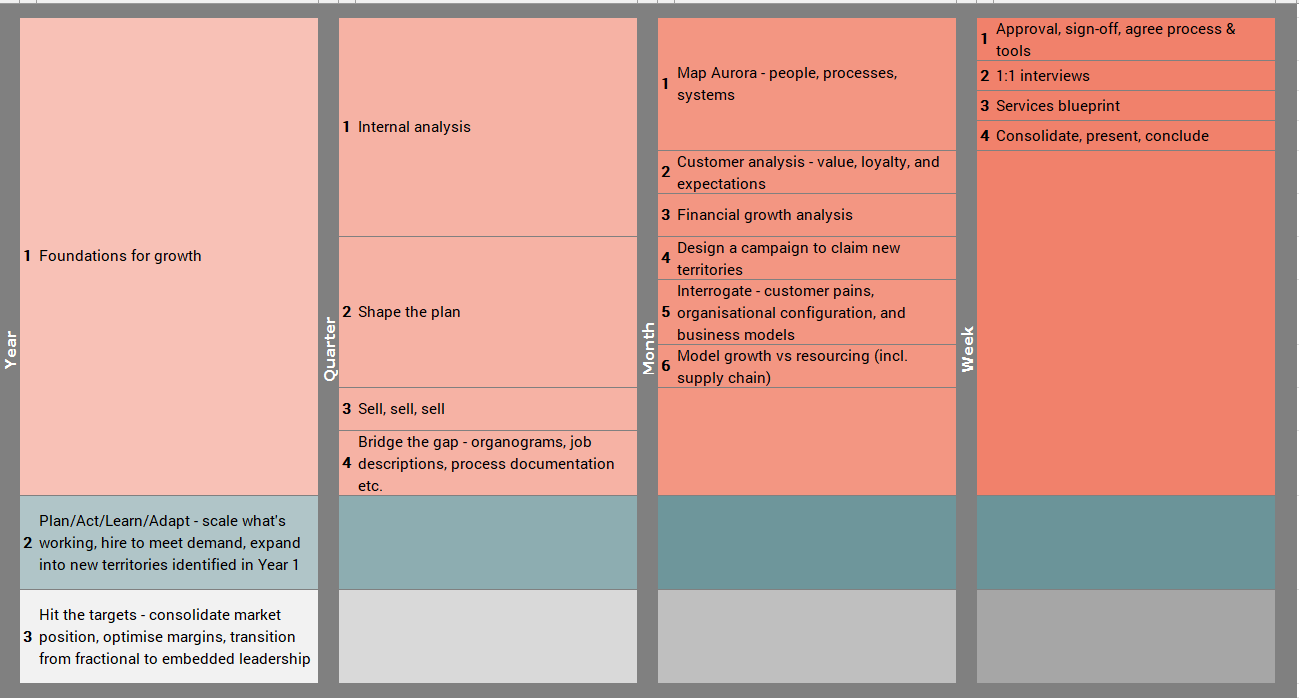
Detailed three month outlook:
Map Aurora - people, processes, systems
1:1 interviews with employees to:
Map the relationships between customers, services, systems and suppliers using a service blueprint structure as a mechanism to:
- Build trust
- Surface perceptions
- Establish appetite for growth
- Encourage contribution
- Plumb collective intelligence
Map the relationships between customers, services, systems and suppliers using a service blueprint structure as a mechanism to:
- Establish a baseline
- Surface constraints and opportunities
- Build reporting frameworks
- Interrogate systems integration
Customer analysis - value, loyalty, and expectations
Analyse customer invoicing history to establish customer value:
Build an ideal customer profile for targeting.
- Value per project
- Customer lifetime value
- Comparative customer costs (incl. cognitive cost)
Build an ideal customer profile for targeting.
Financial growth analysis
Based on our research and conclusions build a growth strategy:
- Set actual targets - what does 10X actually mean?
- Review YOY performance
- Identify primary drivers of revenue and profit
- Analyse sales trends, pricing strategies, and customer segments (based on customer analysis)
- Review working capital, inventory costs and cash flows
Months 4–6 will be planned in detail based on the findings from the first quarter
- Design a campaign to claim new territories
- Interrogate customer pains and business models
- Model growth vs resourcing

Melanie Keartland will be your dedicated point person throughout the engagement.
Growth like this doesn't follow a straight line — although we'll have detailed plans in place, we need to stay open to what we learn along the way and balance discipline with adaptability.
This is why detailed planning for each month is based on the activity that has gone before: Plan, Act, Learn, Adapt.
That said, once a plan of action has been decided, Melanie will drive strict accountability by use of a Kanban board to ensure that the results of our actions are documented and actionable.
Given the time difference between Canberra and Johannesburg, we'll agree on regular time slots that make the most of the overlap — and use async updates via the Kanban board to keep momentum between live sessions.
The expectation from scale-ability is that this is a joint effort, and that Dean will be the primary driver for Aurora in the planning and accountability sessions.
Growth like this doesn't follow a straight line — although we'll have detailed plans in place, we need to stay open to what we learn along the way and balance discipline with adaptability.
This is why detailed planning for each month is based on the activity that has gone before: Plan, Act, Learn, Adapt.
That said, once a plan of action has been decided, Melanie will drive strict accountability by use of a Kanban board to ensure that the results of our actions are documented and actionable.
Given the time difference between Canberra and Johannesburg, we'll agree on regular time slots that make the most of the overlap — and use async updates via the Kanban board to keep momentum between live sessions.
The expectation from scale-ability is that this is a joint effort, and that Dean will be the primary driver for Aurora in the planning and accountability sessions.

Proposed Engagement
We’re proposing a six-month partnership to lay the foundations for Aurora’s 10X growth ambition. Here’s what that looks like in practice.
The engagement provides dedicated fractional support at a notional 60 hours per month. In practice, this typically breaks down as one day per week of direct engagement – interviews, workshops, planning sessions, and stakeholder meetings – with the balance spent on research, analysis, and building deliverables.
Weekly accountability sessions – structured around a shared Kanban board to track actions, decisions, and progress in real time.
Monthly planning – a clear record of what was planned, what was delivered, and what comes next.
Quarterly review meetings – a formal checkpoint to assess performance against milestones, review findings, and set direction for the next phase.
All research, analysis, and strategic planning – from employee interviews and service blueprints through to customer analysis, growth modelling, and campaign design.
Async coordination between live sessions via shared Kanban board.
Investment
We propose a six-month fixed-term contract based on a monthly retainer, to be reviewed and renegotiated based on performance at the end of the period.
Review and continuity
Performance will be assessed at each quarterly review against the milestones agreed at the start of the engagement. At the end of the six-month period, we’ll conduct a formal review and present a recommendation for Year 2 – including proposed scope, structure, and terms. The goal is a seamless transition from foundations to execution, not a cliff edge.
If at any quarterly checkpoint the engagement isn’t delivering the value we both expect, we’ll address it directly – adjust the approach, shift priorities, or agree on an alternative path forward. This is a partnership, not a lock-in.
We’re proposing a six-month partnership to lay the foundations for Aurora’s 10X growth ambition. Here’s what that looks like in practice.
The engagement provides dedicated fractional support at a notional 60 hours per month. In practice, this typically breaks down as one day per week of direct engagement – interviews, workshops, planning sessions, and stakeholder meetings – with the balance spent on research, analysis, and building deliverables.
Weekly accountability sessions – structured around a shared Kanban board to track actions, decisions, and progress in real time.
Monthly planning – a clear record of what was planned, what was delivered, and what comes next.
Quarterly review meetings – a formal checkpoint to assess performance against milestones, review findings, and set direction for the next phase.
All research, analysis, and strategic planning – from employee interviews and service blueprints through to customer analysis, growth modelling, and campaign design.
Async coordination between live sessions via shared Kanban board.
Investment
We propose a six-month fixed-term contract based on a monthly retainer, to be reviewed and renegotiated based on performance at the end of the period.
Monthly retainer, inclusive of all project tooling, coordination, and administrative support | $9 620 |
Review and continuity
Performance will be assessed at each quarterly review against the milestones agreed at the start of the engagement. At the end of the six-month period, we’ll conduct a formal review and present a recommendation for Year 2 – including proposed scope, structure, and terms. The goal is a seamless transition from foundations to execution, not a cliff edge.
If at any quarterly checkpoint the engagement isn’t delivering the value we both expect, we’ll address it directly – adjust the approach, shift priorities, or agree on an alternative path forward. This is a partnership, not a lock-in.
Aurora has spent thirty years building something most businesses never achieve — genuine trust, deep expertise, and a reputation that speaks for itself. The foundations for 10X growth aren't hypothetical; they're already in place. What this proposal offers is the strategy, structure, and hands-on support to turn that potential into momentum. We start with your customers, we let demand set the pace, and we build the systems to match — no guesswork, no bloat, just deliberate, funded growth. The next step is a conversation. Let's sit down, walk through this together, and agree on what the first ninety days look like.
